

The watch dealer looked at the two watches on the table. Same manufacturer. Same reference. Similar year. Comparable condition. He examined them carefully, checked the paperwork and considered recent market transactions.
Eventually, he gave the owners almost identical valuations. From the dealer's perspective, it made perfect sense. To the market, these were essentially two comparable assets.
To their owners, however, they could not have been more different.
The first watch had been purchased three years earlier. Its owner had wanted that particular model, found one at the right price and bought it. He enjoyed wearing it, but if someone offered him sufficiently attractive terms tomorrow, he would probably sell it.
The second watch had been given to its owner by his father on his 21st birthday. His father had worn it before him. There were photographs of the watch at family holidays, weddings and birthdays. Years later, when his father passed away, the watch became one of the few possessions that seemed capable of connecting one generation to another.
The dealer saw two watches worth roughly the same amount. The owners did not.

They can have a market price and an ownership value — and the two are not necessarily the same.

What somebody else is prepared to pay. Observable, comparable, measurable.

What giving up the asset permanently would mean to you. Real, and not observable.

Authenticated independently and held in secure third-party custody.

A genuine sale that still preserves the choice to own it again.
When Price Stops Explaining Value
Traditional finance is remarkably good at determining price. A listed share has a market price. A bond has a yield. A property can be valued using comparable transactions and expected cash flows. Even increasingly sophisticated markets for watches, art, jewelry and collectibles allow us to estimate what an asset might command if offered for sale today.
But price answers only one question: What might somebody else pay for this asset? It does not necessarily answer another: What is this asset worth to me?
For many financial assets, the distinction matters relatively little. One share of a publicly listed company is economically interchangeable with another share of the same class. If an investor sells 1,000 shares today and purchases 1,000 identical shares later, the economic exposure can largely be recreated.
Certain personal assets behave differently. A watch given by a father cannot simply be replaced by another watch bearing the same reference number. A piece of jewelry inherited from a grandmother is not economically identical, in the mind of its owner, to an equivalent piece purchased from a jeweler. A classic automobile owned for thirty years may have a market value, but the memories associated with it are not included in an auction estimate.
This creates what might be called the price of ownership: the additional value an individual places on continuing to own a particular asset, above and beyond what the market itself is willing to pay.
A Difficult Decision
Now imagine that the owner of the second watch is an entrepreneur. His business is successful, but an unexpected requirement arises. Perhaps a supplier offers unusually favorable terms for an immediate bulk purchase. Perhaps a business partner needs capital for a time-sensitive transaction. Perhaps an attractive investment opportunity appears unexpectedly.
He needs liquidity quickly. The watch sitting in his safe is worth a meaningful amount of money. Selling it would solve part of the problem immediately.
From a purely financial perspective, the decision appears straightforward. An asset has a market value; the owner needs capital; therefore, sell the asset and deploy the proceeds somewhere more useful. But that calculation misses something important.
He does not want to sell that watch.
He could sell shares. He could approach his bank. He could dispose of another asset. Or he could simply walk away from the opportunity. Each alternative has a cost.
The watch has a price too. But unlike many of his other assets, selling it may carry a cost that never appears on a spreadsheet: the possibility that he may never own it again.
That changes the economics of the decision.
Not Every Asset Is Fungible
Much of modern finance is built around fungibility. Money is fungible. Listed securities are generally fungible. Commodities are largely fungible. Passion assets often are not.
Two watches may be identical according to a catalogue but entirely different according to their histories.
This is particularly important when discussing luxury assets as part of a modern balance sheet. In previous editions of The Capital Custodia Papers, we have explored how valuable assets outside traditional investment portfolios can represent meaningful stores of wealth and potentially contribute to financial flexibility.
But recognizing an asset's financial value does not mean ignoring its personal value. In fact, the opposite may be true.
If wealth management is ultimately about helping individuals make better decisions about the assets they own, then understanding why they own those assets may be just as important as knowing what those assets are worth.
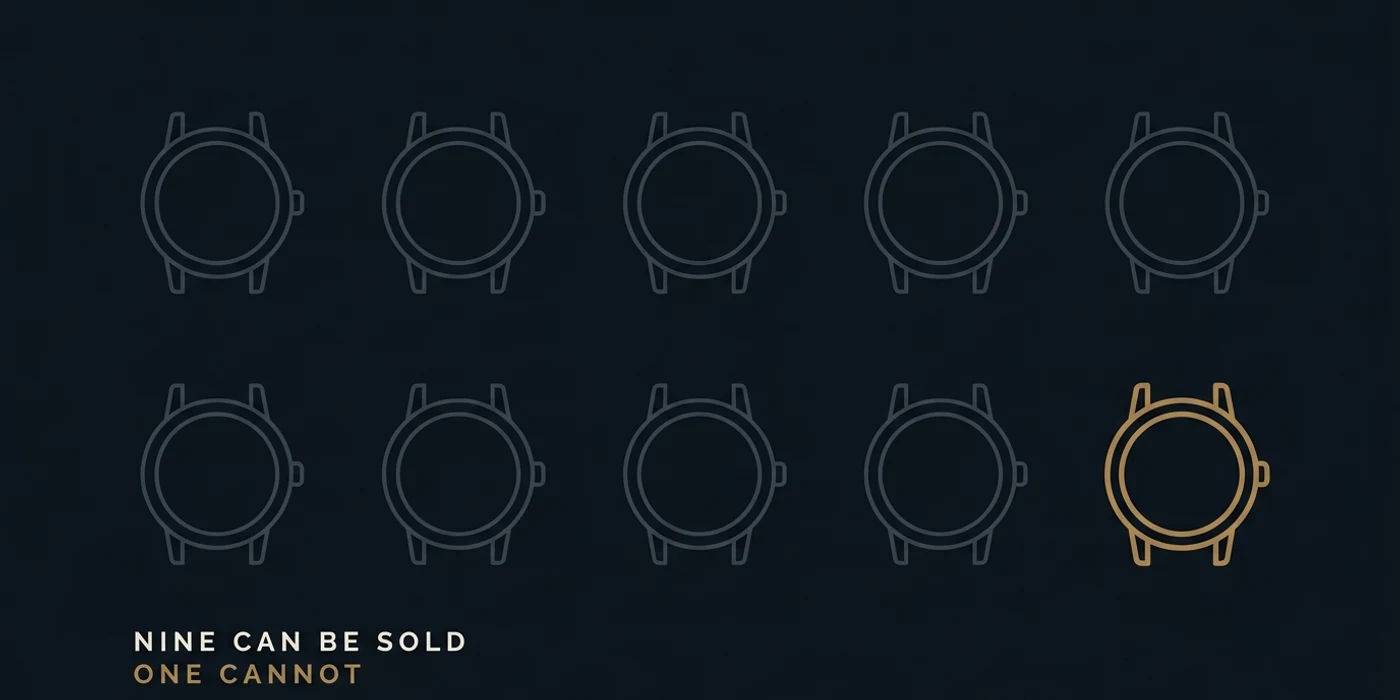
A collector may own ten watches and be entirely comfortable selling nine of them. The tenth may be priceless to him. The market cannot see that distinction. A thoughtful liquidity strategy should.
The Hidden Cost of a Permanent Sale
Suppose our entrepreneur sells his father's watch for $100,000. A conventional analysis records a simple transaction: a $100,000 asset has been converted into $100,000 of liquidity.
But has his economic position really remained unchanged? Perhaps not.
If he later regrets the decision and attempts to replace the watch, he may discover that the same reference now costs $120,000. Even then, he has only replaced the model. He has not replaced his father's watch.
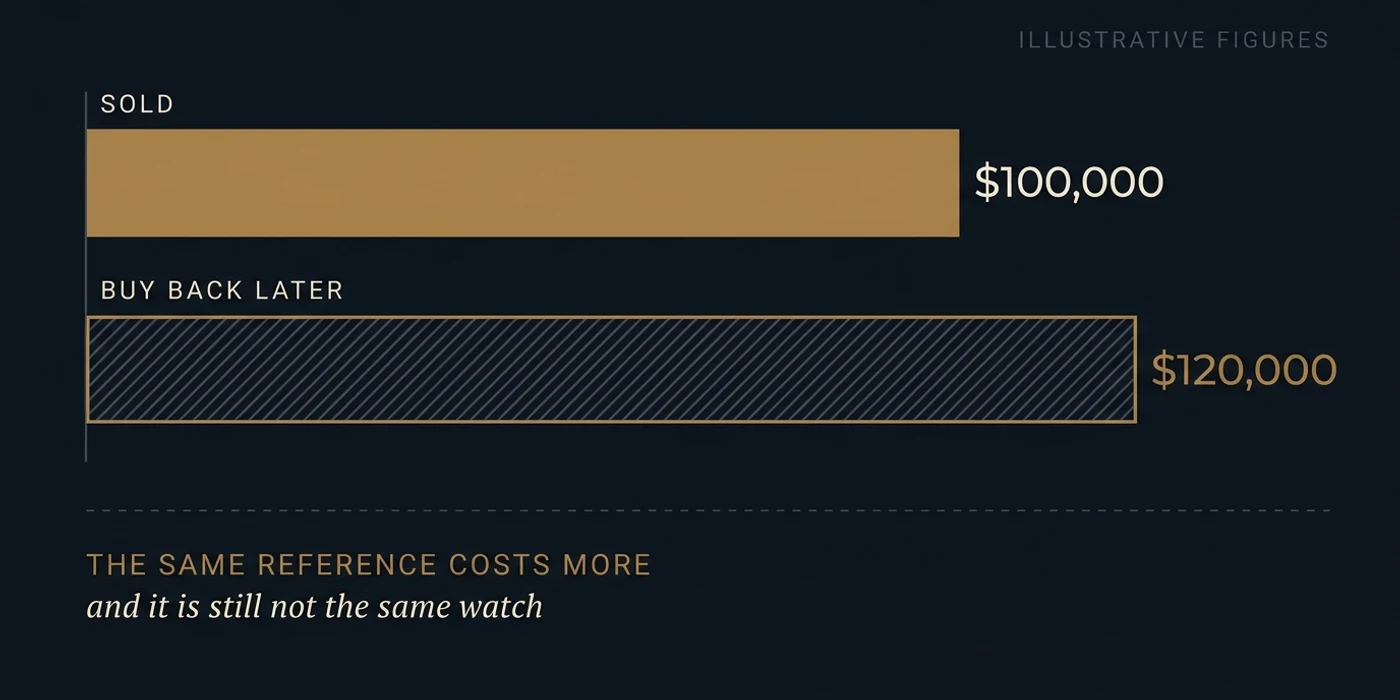
The true cost of the original sale was therefore never simply the difference between the purchase and sale price. Part of the cost was the permanent surrender of ownership.
This is why liquidity decisions involving alternative assets require a different framework from decisions involving purely financial assets.
Sometimes the optimal decision is unquestionably to sell. Sometimes an owner has lost interest in an asset and should redeploy the capital elsewhere. But when the asset carries significant ownership value, the question becomes more nuanced.
Can I create financial flexibility without making a permanent decision today?
Preserving the Choice
This distinction between market value and ownership value is one of the ideas behind Capital Custodia.
We believe luxury watches can be significant alternative assets while simultaneously remaining deeply personal possessions. Those two characteristics are not contradictory.
Our sale transaction with an optional future repurchase is designed around precisely that reality. An owner who requires liquidity can complete a professionally managed sale of a qualifying watch while retaining an independently documented option to repurchase it during an agreed period. During that period, the watch is independently authenticated and held in secure third-party custody with Transguard.
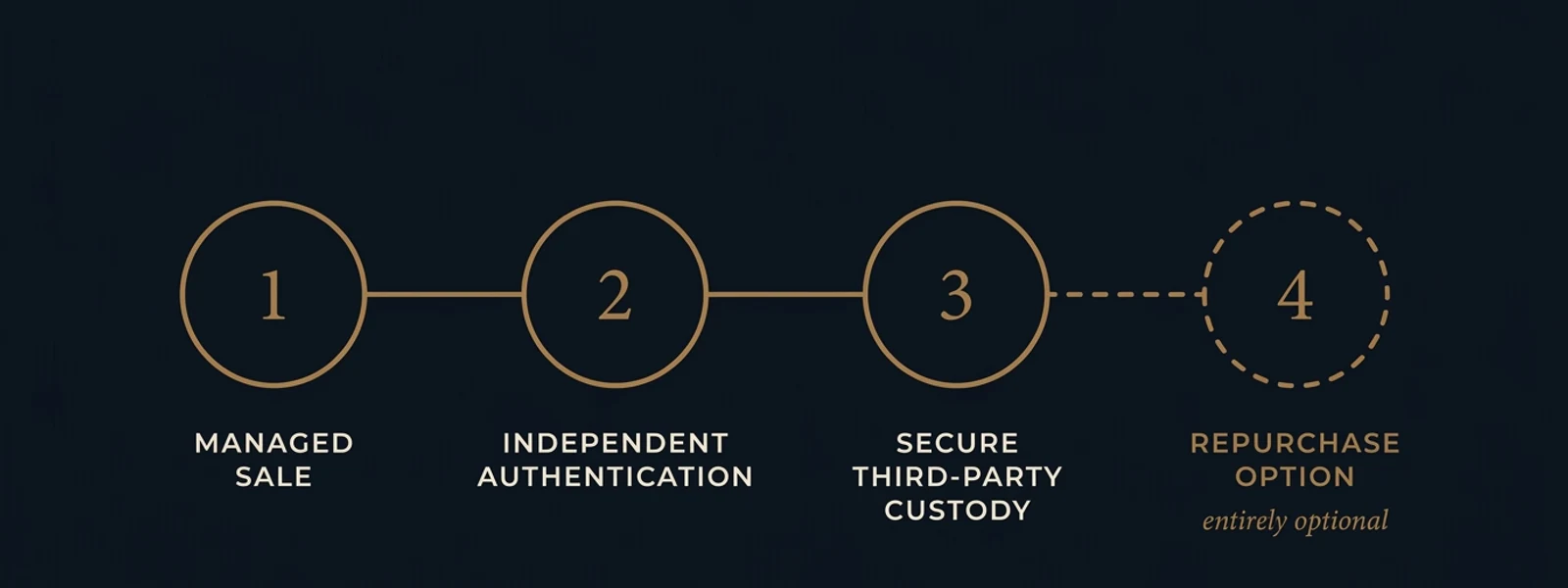
The transaction is a genuine sale, and the decision to exercise the future repurchase remains entirely optional. That distinction matters.
For someone who simply wants to dispose of a watch, an outright sale may be the appropriate solution. For someone whose watch carries substantial ownership value, however, preserving the possibility of owning it again can itself have value.
Capital Custodia does not determine what a watch means to its owner. No valuation model could. Our role is simply to recognize that, in certain circumstances, preserving choice matters.
A Different Definition of Value
The investment world understandably focuses on market value because market value can be measured. Emotional value cannot. But what cannot be measured should not automatically be assumed to have no economic significance.
An entrepreneur who refuses to sell a family business for $20 million when an analyst says it is worth $18 million is not necessarily behaving irrationally. The business may represent identity, control, family history or future possibilities that an external valuation cannot capture.
The same principle applies, on a smaller scale, to many passion assets. Art can represent a period in someone's life. Jewelry can represent a marriage. A classic car can represent a relationship between a father and son. And a watch can carry decades of memories within something small enough to sit on a wrist.
The market can value the metal, craftsmanship, scarcity, condition, provenance and demand. It cannot value the moment a father handed that watch to his son.
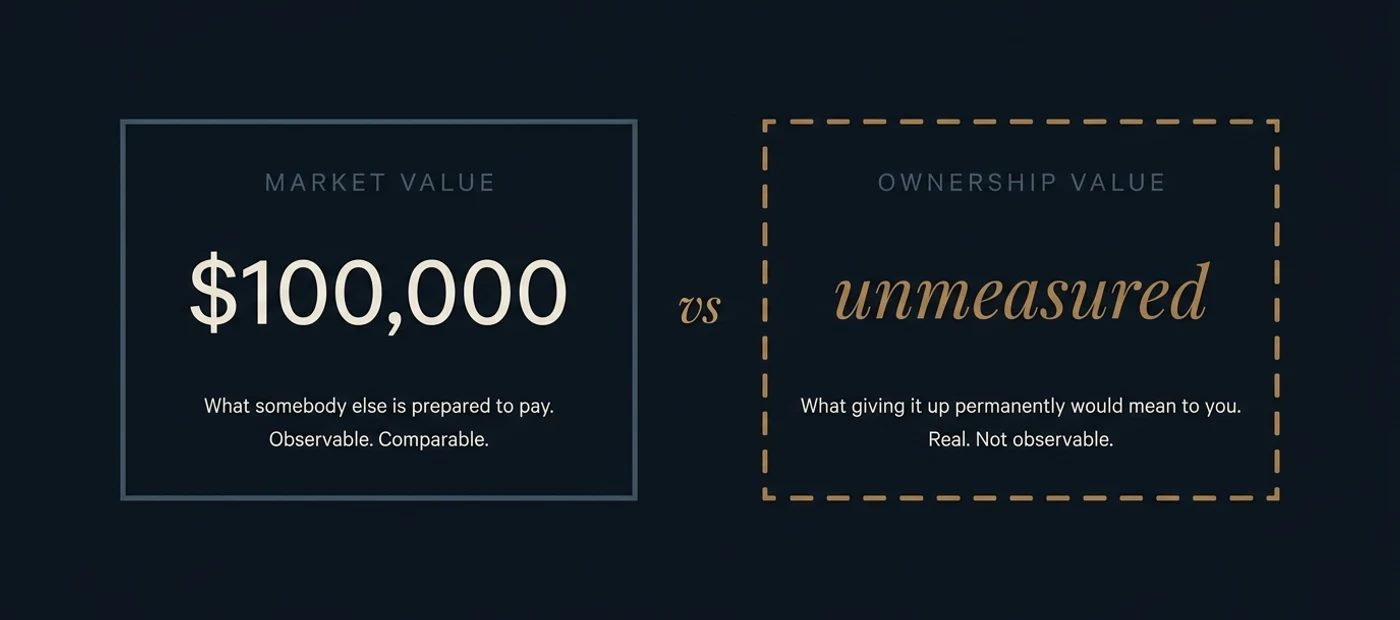
Perhaps sophisticated wealth management therefore requires us to recognize two different forms of value: market value — what somebody else is prepared to pay — and ownership value — what giving up the asset permanently would mean to you.
Neither is more legitimate than the other. They simply answer different questions.
The Price the Market Cannot See
Return to the two watches sitting on the dealer's table. To the dealer, little has changed. Same manufacturer. Same reference. Similar condition. Similar market price. And he is right.
Markets cannot — and should not — price memories.
But the owner of the second watch understands something the valuation cannot capture. One watch can be replaced. The other cannot.
That does not make the second watch financially priceless. It still has a market value and can still be sold. It simply means that before making that decision, its owner should understand what exactly he is giving up.
Because the most important question surrounding a valuable asset is not always: What is it worth?
Sometimes it is: What is it worth to me to continue owning it?
And perhaps that is the real price of ownership.